Land !
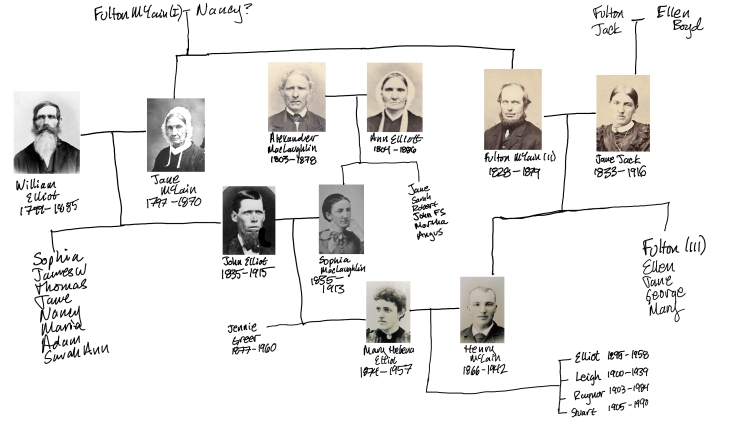
Presumably, many of the McLain ancestors – who all seem to originate in Northern Ireland or Scotland – moved to the USA in search of land. This was the case for many immigrants at the time so we assume that the same was true of our ancestors.
Fulton Jack, who was Henry McLain’s maternal grandfather, immigrated from Northern Ireland to the US in the early 19th century. He purchased 240 acres of land in Michigan from the US government in 1831 under the 1820 Congressional Act for the sale of public lands.

The text of this grant (as far as we can transcribe, it’s quite fuzzy) was transcribed by Neal McLain on the McLain cemetery website.
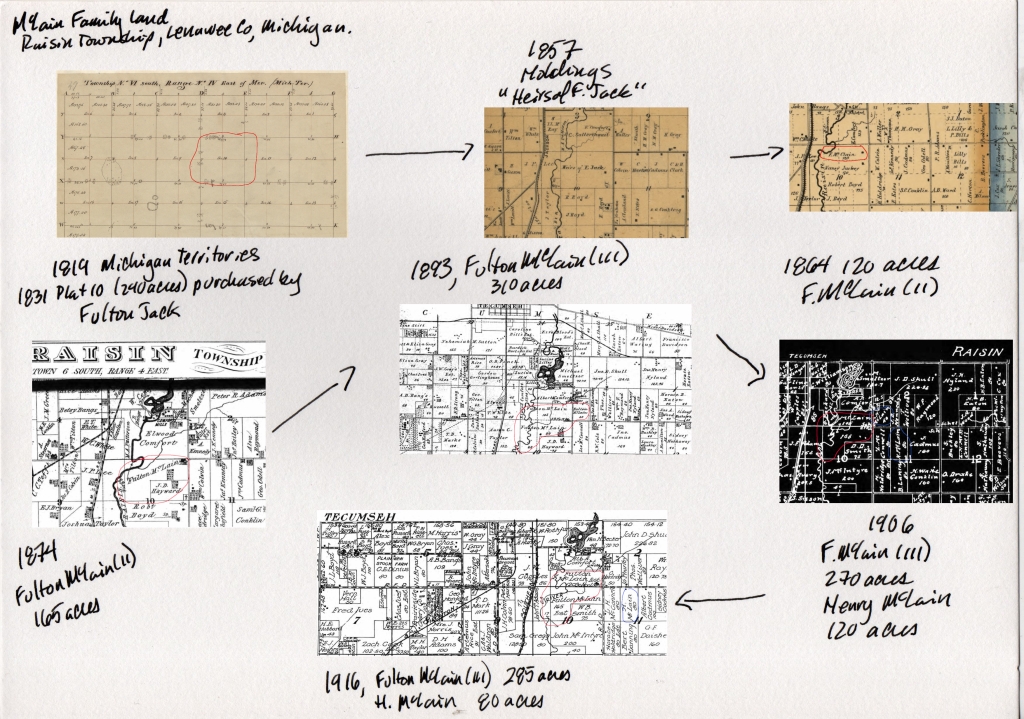
The land was continuously owned by McLains until the 1930s or 40s, or more accurately was continuously owned by Fulton’s until the 1930s or 40s. The image below shows a flow chart of ownership.
History of McLain land in Lenawee county
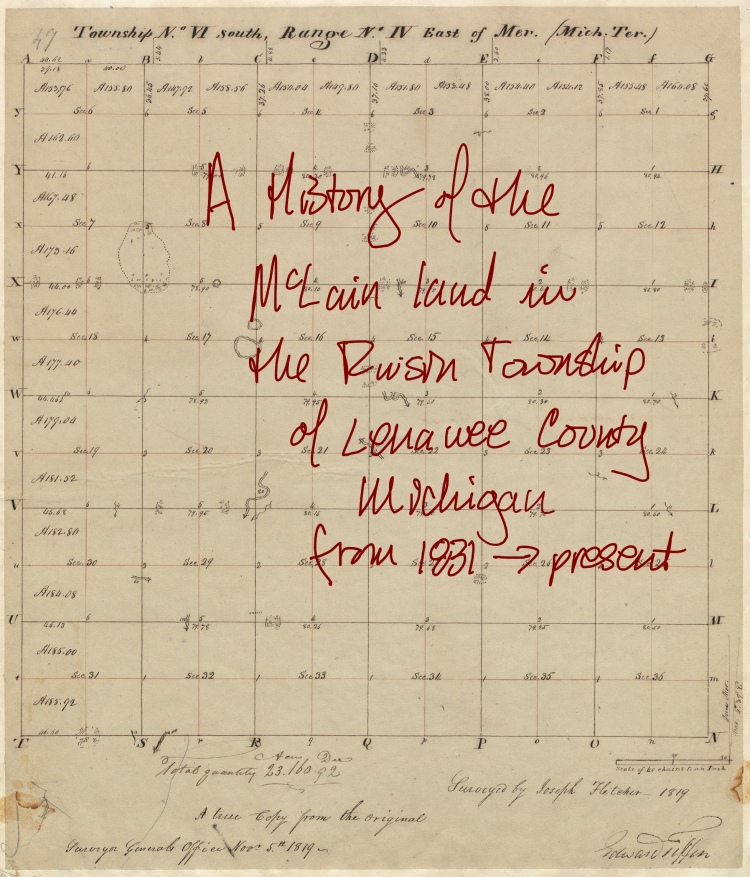
Click on the picture below to view the pamphlet showing the history of the McLain ownership of land in Lenawee County, starting with Fulton Jack in 1831. This pamphlet shows all of the owners of the land from 1831 to present.
After Fulton Jack’s death, this land belonged to Jane Jack. Because married women weren’t allowed to own their own property until 1855 in Michigan, when women were granted a ‘separate economy’ from their husbands, the land became Fulton McLain’s. Fulton McLain II died in 1879, his land had also contracted over his lifetime. Fulton McLain III, being Fulton II’s eldest son, inherited the land and then expanded it, with his largest holding being 310 acres in 1893.
Henry’s Land
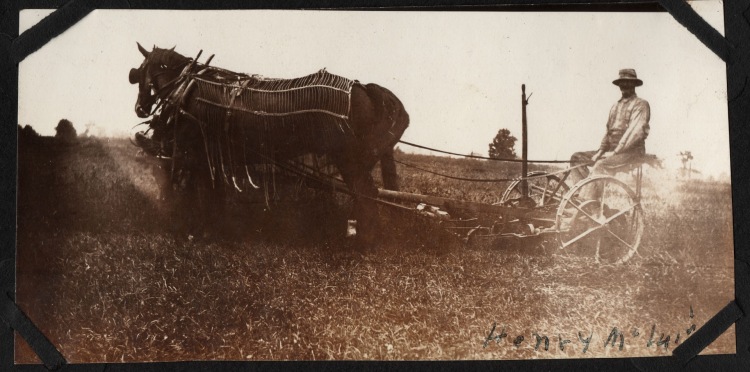
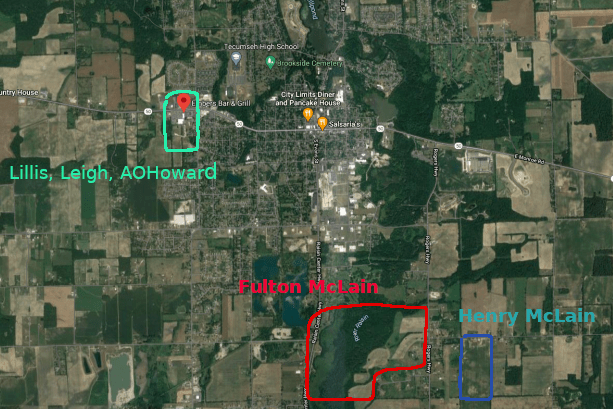
According to the U.S. Homestead and Cash Entry Patents, Henry purchased 160 acres of land on the 27th of May 1897. By 1906, Henry held 120 acres, 40 of which were formerly owned by Fulton III in 1893. The 80 acres of land owned by Henry – across the street from his brother Fulton – is where Elliot, Leigh, Raynor and Stuart all grew up.
The Nature Conservancy – McLain Land now.
Below is a portion of The Nature Conservancy trail map for the Ives Road Fen where you can clearly see the McLain cemetery near the land that is now part of the protected land.

The McLain cemetery in Lenawee Co, Michigan is where most of the McLain ancestors are buried. You can read about the site and more information on the land itself on Neal McLain’s McLain cemetery site.

Comfort Schoolhouse
built by Fulton McLain
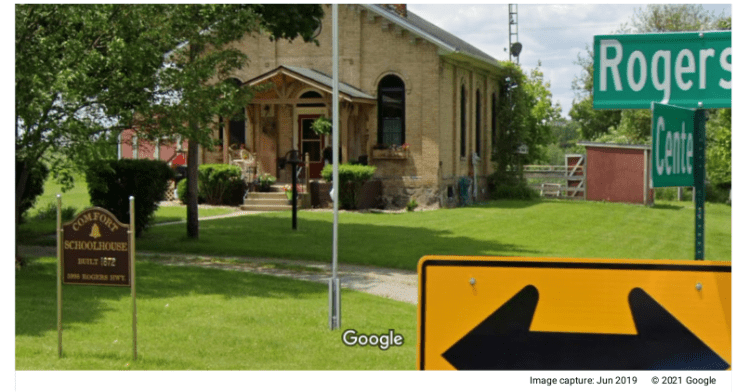
From 1874 onwards, in the top right corner Fulton’s holdings there is a building which is the school house built in 1872. This is a school house which was, we think, was either built by Fulton McLain II or III for the Raisin Township, at least that is the family story (myth?). Who knows why it is called the Comfort School house. The land North of Fulton McLain’s was owned by a man named Comfort so maybe he donated enough money to get named after him, or maybe the new owners just decided to call it that.

This schoolhouse was at some point coverted into a house, complete with linoleum floors, vinyl siding and somewhat scary 1970s faux-wood panelling, you can see it in this state on Zillow. The house was sold in 2019 and restored to it’s original wood-floored/brick state. It looks incredible and even has a sign dating it’s contruction to 1874.
Lillis and Leigh’s farm
Leigh McLain married Lillis Albertine Howard in 1925 when they were living in Kalamazoo, MI. Sometime between 1927 and 1930 they moved back East just outside of Tecumseh – Howard was born in Kalamazoo in 1927 and the 1930 Census places them in Tecumseh.
Leigh, like Lillis’ father Albert O Howard, was a poultry farmer and ran a farm business just outside of Tecumseh near his father-in-law. It may be that Leigh and Lillis farmed the same land as AO Howard. Their farm house, which is now Ember’s Bar in Tecumseh, MI is roughly in the same place as AO’s land in 1916 and AO is listed as retired in the 1930’s census.
These farms were also close to Fulton and Henry McLain’s farm, and also Leigh’s brother Raynor’s farm.
Below is a map which outlines the various properties in Lenawee Co, MI in relationship to one another using the 1916 map markings for AO Howard, Henry McLain and Fulton McLain.
Leigh and Lillis’ was either next door to AO Howards farm or they actually inherited AO Howard’s farm, it is not clear but the map below shows a comparison between the 1916 map (showing AO Howard’s land holdings of 65.61 acres) and Ember’s bar today, which is Lillis and Leigh’s former farm house.
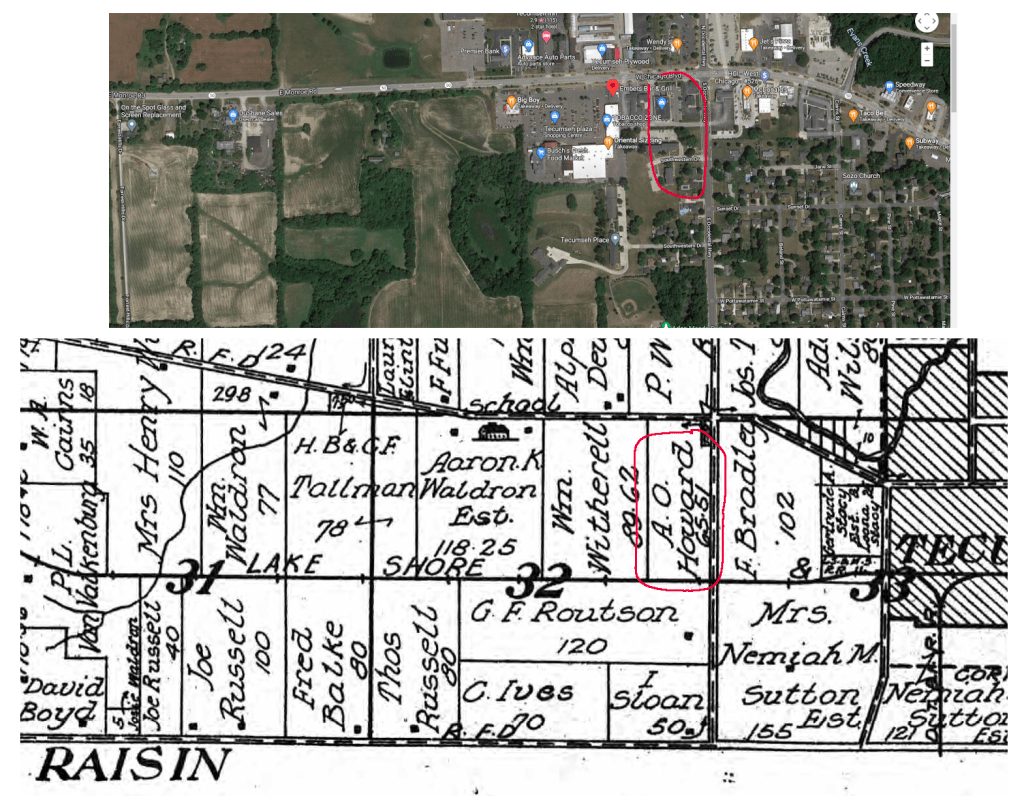
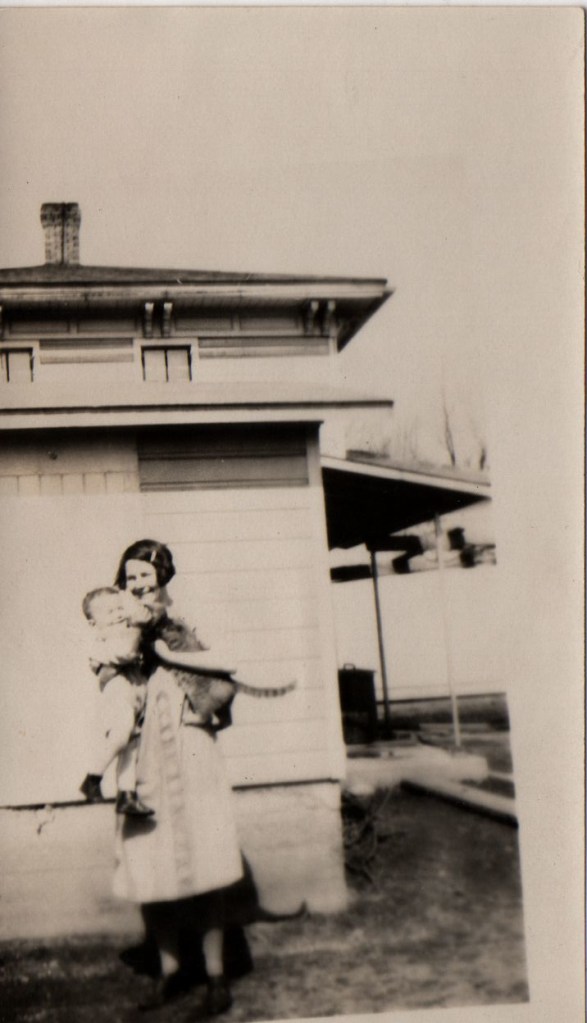
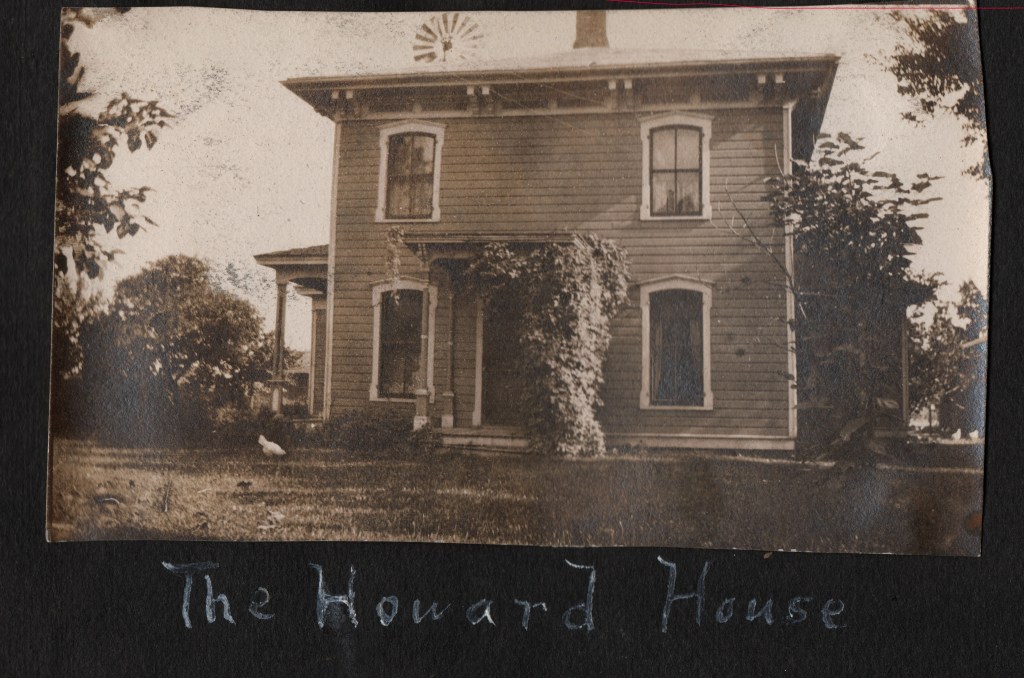
It may be that Embers Bar is the Howard house rather than Lillis and Leigh’s house. All we know is that Howard and Marjorie (Lillis and Leigh’s children) said they grew up in the house that is now Ember’s Bar but we are uncertain which house it is.
Here is Ember’s Bar today.

Elliott land in Leicester, NY
Mary Helena Elliott was from Leicester New York. Her parents, John Elliott and Sophia McLaughlin Elliot, owned a farm, which was inherited from John’s father William Elliott.

The house, which was very large for a farm house, presumably, been built by New York Lt. Governer George Patterson as a summer house. George Patterson was also elected to the US House of Representatives (as a Republican) and served from 1877-1879.
George Patterson, like William Elliott, immigrated from Northern Ireland (he was from Londonderry) in the early 1800s and purchased this farm and built the house. He sold the house and farm to William Elliott – John Elliott’s father and Mary Helena Elliott’s grandfather – around 1853, if not earlier. Below is the 1850 census which shows William as a farmer and all of the Elliott children who were still on the farm with him, it is not clear if this is the same farm but it seems likely.
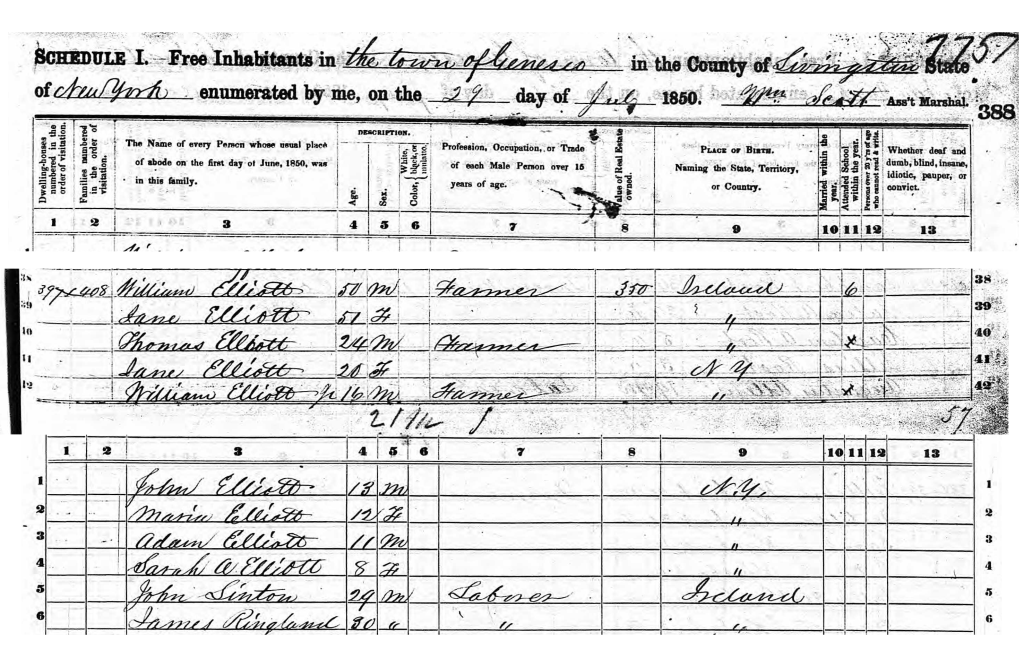
At some stage, John inherited the farm from his father William, perhaps when William died in 1885. The map below shows John owning the farm in 1906.
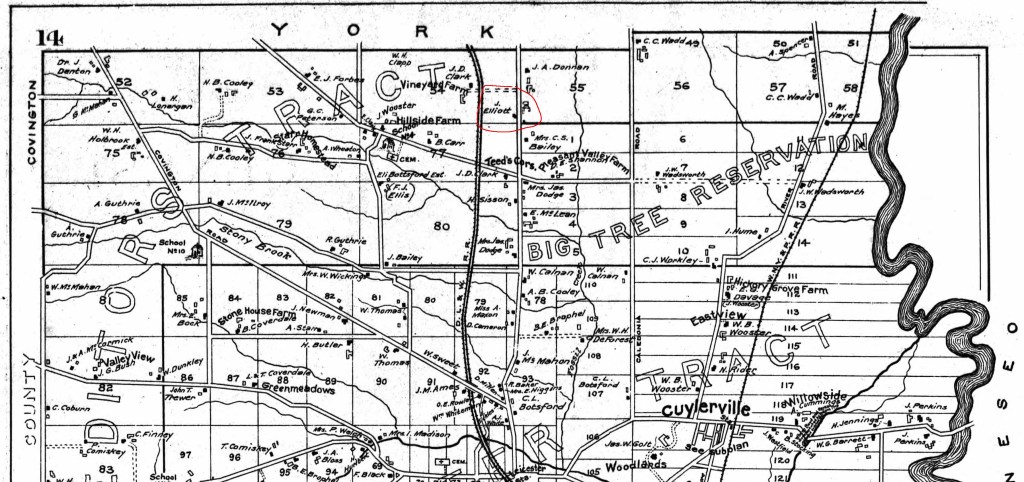
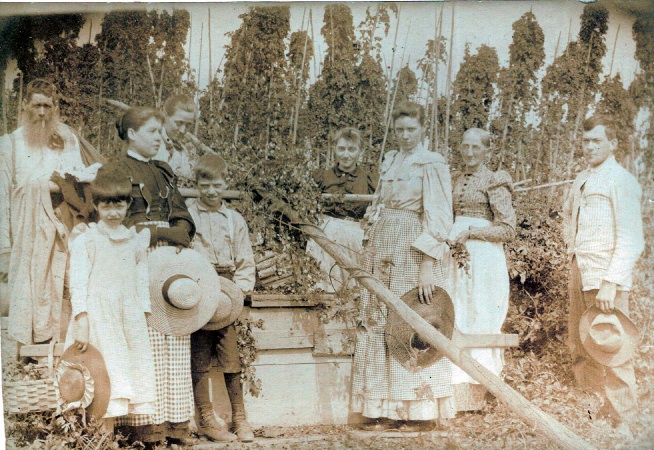
On this farm, the Elliotts raised sheep for wool and perhaps for lamb as well. They most definitely grew hops, maybe after William Elliott passed on as he was a teetotaller, according to his obituary.
Here are the Elliotts harvesting said hops in 1895.


 Henry's boys